Thursday, September 3, 2020

Exocytosis, Stage Left: Coronavirus strategies for spreading infection

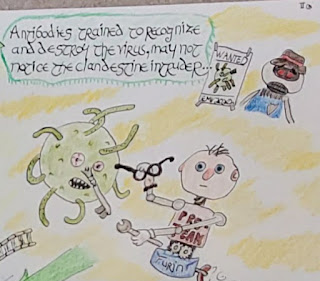
On a cellular biology level, learning about SARS-CoV-2 opens up a micro-world of epic struggles: stealth and trickery, strategem and counter, adaptation and (usually) survival. This is an early stab at the fifth panel for the redo of Bat Soup: the Graphic Novel in which we attempt to teach really tough biology concepts in a fun way. In this panel, we show the strange ways the virus spreads itself once it successfully enters the cell, takes over its machinery, and  forces the ribosome to start transcribing its proteins to make copies. When I have it where I want it, I will do the final copy on an 11"x14" Bristol Board where I will able to get finer detail with a less cluttered layout.

Endocytosis: In previous panels, we show the dastardly virus using a disguise to evade the immune system to successfully approach the cell. Its spike protein is initially rotated downward and harder for the immune system to recognize. The virus makes use of a host pro-protein such as furin to properly align the spike protein at the S1/S2 boundary so it can activate the ACE2 receptor to make entry into the cell (endocytosis).
The SARS-CoV-2 virus needs a human proprotein, furin, to correctly position its spike protein at the S1/S2 boundary before it can invade a cell.
Snippet from Panel 1

Infiltration and Replication: Once inside, the coronavirus then makes further use of existing human proteins such as cathepsin to unpack its payload and start transcription of its own proteins encoded in its RNA genome. At about 30,000 basepairs, these SARS coronavirus are among the largest and most complex RNA genomes known. So, now that the virus has taken over the cell's fabrication facility, a fleet of new virus particles is being constructed!

So what happens next? Most (lay) descriptions of viral replication just say that the virus causes the cell membrane to rupture so it can surge forth and infect more cells. With most viruses, there is more to it than that and, anyway, with the SARS viruses, particularly SARS-CoV-2 it takes a very different path-- mediated by the "non-structural proteins" in its complex genome which is only partly understood. Programmed cell death, "Apoptosis", does likely happen, but the virus has already spread by then and it is done for a much more cunning reason (which we'll get to in Panel 6).
In the meantime, though, in Panel 5: the viral horde is unleashed.

Viral proteins are synthesized and folded in the Endoplasmic Reticulum and then packaged in smooth-walled vesicles; these vesicles can then merge with the cell membrane to release mature virus into the intercellular space; leaked S-proteins can also cause nearby cell-membranes to merge, allowing virus to directly invade neighboring cells
Bat Soup, the Graphic Novel, Panel 5 concept sketch
The Endoplasmic Reticulum: A long time ago in a galaxy far away when I tutored Cell Biology to make a little side money for college, the Endoplasmic Reticulum and the viral transcription process was something most people seemed to have trouble with. It's extraordinarily complicated, and we are still learning. But I always found it helped to picture it like an WWII-era industrial complex, tiers of concrete and banks of windows (some of them are broken out) rising, the ribosomes stuck to the sides. This is the Rough ER, where the magic of protein synthesis and folding happens. I then picture the Smooth ER, where lipid synthesis happens (the stuff that makes cell membranes, among other things), as rising stacks because they are round and smooth like chimneys or pipes. The nucleus is a walled-complex just beyond the factory.

This is the structure the virus has taken over. The ribosomes start decoding RNA sequences: cytosine, guanine, adenine, and uracil, and stringing together chains of amino acids, the building blocks of proteins. But finished proteins aren't just strings of amino acids (AAs), they are complex 3D structures. The Endoplasmic Reticulum is where those chains of AAs are folded into completed structures like enzymes or hormones... or the shell of a new virus particle.

Exocytosis: Once the viral structure is fabricated, the replicated RNA strand is placed inside and the whole assembled inside smooth-walled vesicles small bubbles inside the cell which are made out of pieces stolen from the Endoplasmic Reticulum. The result is little packets of virus-laden food service condiment packets (extra spicey!) being arrayed inside the cell. But the virus does not have to burst the cell open to escape. At the command of virus-provided S-proteins, pores form in the surface of the cell and merge with the smooth-walled vesicles, pouring virus into the intercellular space (the spike protein once more disguised) where they can find more cells to infect. This is "exocytosis".

Synctium: But, this virus has another trick for avoiding the immune system, particularly deep in the lungs: it doesn't have to leave the cell to spread. The hostage cell starts leaking S-proteins into the intercellular fluid. The S-proteins cause the cell membranes of nearby cells to merge together. Long multinucleated cells called "synctium" start to form which share the same cytoplasm-- and the same viral infection! As we will see in future panels, the cell, including these multi-nucleates mega-cells, can end up dying several different ways.


This cycle of formation of mega-cells, their destruction, and the body's attempt to heal and regrow tissue is a big reason the virus can cause such massive tissue damage and scarring inside lung tissue. The immune response often makes the situation even worse. Understanding how it works and why some people get away with minimal damage may be a key to effective treatment of severe cases.

Thursday, March 12, 2020

Bat Soup, the Graphic Novel - How SARS-CoV-2 enters a cell


Today we get a quick dose of microbiology and an explanation of how Bat Soup, 2019-nCoV, SARS-CoV2, (whatever you wish to call it, see a note about disease names at the bottom!), gains access to a cell and starts to infect a human host.
The more basic information people know about this disease, the more tools they have to interpret the news reports (which are often very poorly done by people who know no more than you do). This gives you a chance to make rational decisions, maybe understand what to fear and what not to. My background is described at the top of the Bat Soup for the Soul: Teaching with Coronavirus article I wrote previously.

This particular virus uses a vulnerability in the Angiotensin Conversion Enzyme 2 (ACE2) found in many human cells and, in particular, epithelial cells (lining) in the lower lung. This is the same receptor used by SARS-CoV, but quite different from MERS-CoV, the common flu, etc.


Note here that there are plant compounds or "phytochemicals" which also bind weakly to this receptor and may inhibit (temporarily block) viral activity. Host receptor blockage by phytochemicals or synthetic compounds is a hot area of antiviral research. The object, of course, is to find something which inhibits the virus without itself causing damage to humans. There are actually a substantial number of naturally-produced compounds which might do the trick with COVID-19. None have been clinically proven yet, though a few had some potential effect in studies with the original SARS outbreak in 2004 or show antiviral activity in vitro (in a test tube) or an animal model.
 
 
The coronavirus really does look a bit like a hairy ball (that is where it gets its name), but I have used a tiny bit of artistic license here.

The ACE2 receptor is part of the Renin-Angiotensin System, or RAS. The RAS regulates a number of important body functions, including respiration, heart rate, blood pressure, and kidney function.  Some of you make take medications which target angiotensin or the ACE (Angiotensin Conversion Enzyme, part of a set of related functions with ACE2). These medications, called ACE inhibitors, may cause or indicate potential complications for Bat Soup, but this is still being researched. In any case, the virus, in addition to hijacking the cell for its own purpose, causes collateral damage to the RAS and complications throughout the body of the human host.

After gaining entry into the cell and using its own machinery to replicate, the cell dies and releases more virus particles to spread further. The human body has mechanisms to try to detect and destroy these hijacked cells before they release a virus cargo (also used to fight tumors) a cytokine called TNF (Tumor Necrosis Factor). When the immune system overreacts, cytokine's go crazy attacking everything in site, causing cell damage, inflammation, viral pneumonia, etc. in what is referred to as a "cytokine storm". It is though by many researchers that the cytokine storm may be triggered as a tactic by the virus, like causing a large-scale riot to cover up a break-in in a particular building. The chaos caused by the cytokine storm permits further and faster infection and may become deadly in its own right but is very hard for modern medicine to treat.

This is, of course, a very simple attempt at explaining a complex topic. More references are included below for the adventurous reader to explore further.

References

  • Buhner, S. H. (2013). Herbal Antivirals: Natrual Remedies For Emerging and Resistant Viral Infections (e-book). Massachusetts: Storrey Publishing. Retrieved from https://www.scribd.com/book/176719013/Herbal-Antivirals-Natural-Remedies-for-Emerging-Resistant-Viral-Infections
    • Includes an in-depth section on SARS, the ACE2 receptor, and potential phytochemicals, including sources, studies, and preparations. Extremely in-depth material, but the best one-stop source for plant compound antiviral activity, research, and practice.
  • Chen, H., & Du, Q. (2020). Potential natural compounds for preventing 2019-nCoV infection Hansen. Preprints.Org, (January). Retrieved from https://www.preprints.org/manuscript/202001.0358/v1/download
  • Wan, Y., Shang, J., Graham, R., Baric, R. S., & Li, F. (2020). Receptor recognition by novel coronavirus from Wuhan: An analysis based on decade-long structural studies of SARS. Journal of Virology, (January). https://doi.org/10.1128/JVI.00127-20
  • Bat Soup for the Soul: Teaching with Coronavirus describes disease models and spread statistics to the non-epidemiologist with graphical illustration.
  • The Confusing World of Disease Mortality Statistics in Simple Numbers
If you want to learn more about the general mechanisms of viruses (e.g. influenza), there is an excellent online Virology 101 course/podcast with plenty of diagrams and examples (free).

An Explanation of Names


When it was originally discovered, this virus, which was found to belong to the general family of the coronavirus, was simply labelled 2019-nCoV or "2019 novel coronavirus", novel, here, meaning simply previously unknown and poorly understood. As more about the virus was learned, it was renamed to SARS-CoV-2, formally signifying that it was closely related (but not identical to) the SARS outbreak of 2003-2004. The disease the virus causes is called COVID-19 (Coronavirus disease of 2019).

The two names can be a little confusing, but it is similar to HIV/AIDS: the human immunodeficiency virus (HIV) causes AIDS. Most of the time, the names can be used interchangeably unless you wish to make it clear that you specifically mean either the virus itself or its disease in humans. "Coronavirus" is often an acceptable shorthand as long as it is clear that it potentially refers to more than one virus which affect both humans and animals.

I started using the nickname "Bat Soup" before a formal name had been decided on, based on the urban myth (almost certainly not true) that the original victims got the virus from eating undercooked bat soup. In any case, this tiny virus has put many people in "deep soup".

Wednesday, March 11, 2020

The Confusing World of Disease Mortality Statistics in Simple Numbers

2b/~2b: 'How Many?' is the question!

There is a lot of confusion and debate over mortality figures for novel coronavirus (COVID-19, formerly 2019-nCoV). Most people see the numbers but do not understand how they are derived and therefore may be confused on how to compare numbers from different outbreaks or even the same outbreak on different days or different sources.

As discussed in my previous article, "Bat Soup for the Soul: Teaching with Coronavirus", the simple answer to how deadly this new virus is is that it is a good deal less deadly than SARS-CoV was and a good bit more deadly than the seasonal flu (but affects somewhat different age-groups--- out of scope for this article). At the same time, it is markedly more transmissible than SARS was and somewhat less transmissible than the flu. So, bottom line is that it does less damage on an individual basis than SARS but already has affected many more individuals (and continues to do so). Similarly, it is likely to spread less effectively than the flu but hurt more of the people it does infect (especially the elderly).

[Version 1.1 20200311: corrected typo in equation. Thank you CEMV!]

Less Deadly Is Not Always 'Good'

In general, we often see that less deadly diseases spread faster for the simple reason that people who get quickly and desperately sick do not tend to want to run around and spread disease! When someone has only mild symptoms or takes longer to get sick, they have opportunities to pass the infection to more people. But let us take a quick look at how the mortality figure is derived and why estimates may differ very sharply. We will walk through the math but with deliberately very simple numbers to start:

Let's say you have an outbreak with 20 people infected. At the time we measure, there are 5 fatalities, 5 serious cases, 5 recovered cases, and 5 mild cases. What is the fatality rate?

The quick answer is to divide 5 fatalities by 20 total cases for 25%:

5/20 = 0.25 = 25%

This is more or less the type of number often published for COVID-19. At this moment, using Johns Hopkins' tracker, you get:

4,373 deaths / 121,564 total cases = 0.35981047 or 3.6%

Don't put ANY stock in that specific number because it will be different by the time you read this. If you take this number at different times over the outbreak, the number varies somewhat, and the numbers published by various clinicians or regional authorities vary a great deal because they are taking numbers from their specific populations. Depending on what numbers you use, you can get anywhere from 0.7% to almost 8%, for instance, from different phases of the outbreak in China (according to WHO's report on the Joint Mission to China at the end of February).

OK, so why are people arguing about this? Why are some people saying the number is "wrong" or "likely wrong".

Well, there are a couple of issues with using this number reflexively.


Crude Mortality versus Completed Cases

First, the number is subtly wrong from the way most people think of the probability of dying from a disease. The number above is really what is often referred to as "crude mortality" because it includes uncompleted cases. What does that mean?

In our first set of numbers, we have 10 people, 5 serious cases and 5 mild cases, who have neither recovered nor died (yet). Presumably, they will do one or the other eventually. When looking at past epidemics, like the final numbers for the SARS outbreak in 2004, every case is completed because no one is still walking around actively infected with SARS-CoV-1! So let's fix the number by only including completed cases:

5 deaths / (5 deaths + 5 recovered) = 0.5 = 50% (!)

Ten people total in our example have either died or recovered, so that goes on the bottom. With the other ten people we simply do not know (yet) what will happen. Hopefully that makes sense so far. Mortality calculated from completed cases will tend to be higher for an active outbreak versus a past outbreak, so one must take some care comparing typical actively reported numbers versus historical. But it takes time during an outbreak to get statistically meaningful numbers of recovered cases, so crude mortality is usually what you get.

To take real coronavirus numbers further, we get:

4,373 deaths / (4,373 + 66,239) =  0.061929984 or 6.2%

This is usually what people are really thinking of when they ask "If I am in fact infected, what is my chance of dying once the disease runs its course?" As you can see, it is worse than the crude mortality frequently published. If only two of the serious cases later die and the rest recover, you will see yet a different (lower) number. But wait...

How Many People Actually Get the Disease?


The number you get is clearly heavily influenced by the number of cases of infection you use in the first place. Is this number "correct"? Well, probably not, and how much it is off is a matter of great debate. What happens if you are "infected" but have a mild case (or maybe do not even notice) and never get tested? You won't be included in the numbers at all. Going back to our simple example, if we say that the mild cases are simply never noticed, we get:

5 deaths / 15 cases = 0.333... or 33%

This number is higher than our initial 25%, but we know it does not actually reflect reality. So, let us say that instead of 121,564 cases of COVID-19 world-wide (the confirmed case count from above), we actually have one mild or asymptomatic case for each confirmed case, someone running around who may think they merely have a cold or whatever. Then we get:

4,373 deaths / 121,564*2 total cases =0.1798641 or 1.8%

Well, that looks better, doesn't it? This is the kind of thing you will see in many estimates of COVID-19 mortality, depending on what they use as their guess of how many mild or asymptomatic cases there are. In theory, the unknowns could affect the death count as well (two of the confirmed cases in Washington state were diagnosed postmortem), but we tend to be a bit better at noticing when someone actually keels over as opposed to when they just have a sniffle for a day or two.

Getting Actual Numbers

So, how does one figure out which number is the "correct" number to use for actual cases? How do you account for what you do not know?

Well, people guess from various disease models based on past outbreaks or on detailed numbers from one part of an outbreak. But the tried-and-true method is to swab and test everything that moves throughout a community (at least on a random sample basis) to find out how many people running around have the disease but have not actually showed up at a hospital. China, after a very rough beginning, has started to do this and, as a result, their case-counts, while initially sketchy, are a great deal more reliable. They did actually find unreported cases lurking around the community, mild cases, cases mistaken for something else, people afraid to report, etc., but not that many. South Korea has also done extensive testing around their outbreak (and, interestingly enough, their mortality figures are closer to 0.7%, at the low end of what China found).

The US has done very little of this at all and has suffered from a chronic shortage of test kits. Numbers for our domestic outbreaks (and consequently, estimates of mortality in the US) are therefore extremely poor. Presumably, if we actually had the foggiest clue how many people were infected, our mortality figures would be much lower than they appear. But we just do not know--- and cannot until the test kits catch up, which they are starting to do as of this writing on 11 March.

Be aware, then, if you use global case-counts and deaths, you are getting a mixed bag of both good data and bad data. That results in a number which--- well, it isn't wrong, it is a calculation, and it is what it is, but--- may not be very reliable from predicting the future. Using numbers from countries or regions we know have better data may give better results, but then you have to ask yourself whether the results China gets in their health system or South Korea in theirs will apply equally to the US population and our health system. Roughly, perhaps, but never exactly. HIV spread very differently in European populations than in African populations to what turns out to have been a genetic leftover from bubonic plague: that stuff happens and is inherently unpredictable.

Conclusion


So, what then? What conclusion can we solidly make?

Well, we come back to the beginning: "a good deal less deadly than SARS-CoV was and a good bit more deadly than the seasonal flu". (And, by the way, this virus seems to leave (most) children (<20 years) alone, and that is rather interesting, isn't it?)

Tuesday, January 28, 2020

Bat Soup For the Soul - Teaching With Coronavirus

It is time to speak of many things, of cabbages and kings, of why Bat Soup is boiling hot and whether it has wings...

There is a great deal of media discussion about the 2019-nCoV, 2019 Novel Coronavirus, outbreak in Wuhan China. Some are predicting dire catastrophy, others are saying it is just a distraction from impeachment. The problem is that most people do not understand viruses or epidemiology enough to judge what is being written, to understand whether this or that recent news is important. I am, myself "concerned" about the outbreak, very concerned about the catastrophe for the victims in China and "somewhat concerned" about what may happen here. I also see this as a "teaching moment" to try to explain some of the concepts behind the progress of and efforts against the disease.

  • Draft 1.1.1 11 March 2020 - Added link to Flatten the Curve chart (#FlattenTheCurve) and some discussion at end of article now that we have community spread in the US.
  • Draft 1.1 2 February 2020: Added, briefly discuss, a Lancet paper presenting a more involved (SEIR) model. Editorial corrections. Organized References. 1.1.01 same day: typo correction.
  • Draft 1.01 29 January 2020: Corrected significant typo in discussion of Basic Reproduction Number. Thanks CEMV;
  • Draft 1.0: 28 January 2020. Initial complete text. Needs a proof-reading pass or two, apologies.

If you are in a real hurry and do not have time to learn the underlying how and why, this same basic thing is presented in one chart as Flatten the Curve. I discuss this idea a bit more at the bottom and why we have suddenly gone from trying to "stop" the virus to spreading it out in time. (Thank you, Christie!)

Personally, I went from college (Environmental Science) to Air Force Studies and Analyses. My thesis was the production of a computer simulation toolkit for environmental and biological systems in C++. When I was learning these things, the computer resources for exploration were either not available for students or extremely expensive, and I added to the pool of such tools available. At the Pentagon, I mainly supported intelligence analyses using computers: improving, maintaining, and writing tools to analyze intelligence data, including Nuclear, Biological, and Chemical (NBC) warfare models. Since I did not have formal training in epidemiology, I had to learn much of it the hard way, talking to people who did and entombing myself in the Pentagon library for days-at-a-time until I understood what I had to make the simulation simulate, making mistakes, and doing it again until the mistakes went away. That experience does not make me a virologist or an epidemiologist now, but it means I have enough background to understand the papers being published and the data about the course of the disease.

[If you are dumb (or determined?) enough to try to learn the same why I did, some useful starting points are given at the bottom...]

I am going to try to explain some basic principles here about how some of the data coming out of China might affect the United States if the virus spread across the Pond and achieved effective human-to-human transmission here. What I am going to show you is not a predictive model but a teaching tool to understand how such a disease might progress in a large population with no effective medical prevention. Clearly, medical intervention will be attempted and some of it undoubtedly will be successful. The use of this model is to show what those medical efforts need to prevent and some of the issues involved.

If you are math challenged, don't worry about the equations as much. The graphs should give you a feel for what is happening. If you like math, the equations included will give you a means to play with the numbers yourself.

(Brief) Background On the Virus


The 2019-nCoV is a coronavirus which has been discovered in Wuhan, China related to two previous disease outbreaks, SARS-CoV (Severe Acute Respiratory Syndrome) and MERS-CoV (Middle East Respiratory Syndrome). The coronavirus family normally produces disease in bats, not humans. 2019 Novel Coronavirus is just a placeholder title for a specific coronavirus which in some way has learned how to infect humans. The scientific community has not come up with a handier title yet, so for ease of discussion and in honor of the popular (but likely incorrect) idea that it came from eating bat soup, I am going to refer to it as the Bat Soup Surprise Virus, "Bat Soup" or BSSV for short.

As of this writing, Bat Soup has infected roughly 4,000 people, almost all in China of which almost 100 have died. There have been 5 confirmed cases in the US, but all of these are imported cases, people who were infected overseas before coming to (or returning to) the US. I am not even going to try to print and cite up-to-date numbers here because they are changing too rapidly.

Animal viruses do cross over to humans from time to time. In many cases, they fail to effectively replicate in humans and therefore simply fizzle out. This virus is concerning because it has demonstrated sustained human-to-human transmission over more than five generations of confirmed cases and does not show signs of weakening. Attempts are ongoing to contain it to China, to locate, isolate, and treat the leakers who have brought the disease to other countries. In China, a large scale quarantine has affected more than 55 million people, including 11 million in the greater Wuhan area and 33 million in a neighboring city. The CDC is working to track contacts of infected people who came to the US and to process test samples to determine who among them may have the virus. This kind of effort is precisely what stopped the spread of SARS in 2003-2004.

Compared to SARS or MERS, this virus is more contagious but considerably less lethal, making it more likely to escape containment and spread but likely to cause fewer fatalities if it does. SARS had a case-fatality rate of about 10%, MERS about 37%; the Spanish Influenza of 1918 somewhat less than 5%; this disease is variously calculated at 4% or 3% and (for a variety of reasons) the actual number is likely to be lower as (if) it spreads.

The Basic Reproductive Number


A critical number for understanding disease epidemics of any type is the Basic Reproductive Number or R0 (often pronounced "R-nought"). This is often talked about but seldom actually explained. The Reproductive Number is the average number of successful transmissions of the disease from one individual. If one person manages to infect two other people (before recovering or dying) and each of those new infected people manage to each infect two other people (and so on), then the Reproductive Number (R) is 2.0, as shown in the following illustration:
Note that R is really an average. Bob might infect 4 people and Susan only 1 (avg = 2.5). It depends both on how contagious the disease is and on how many people Bob and Susan regularly come into contact with! For the same reason, R will almost certainly change over the course of an outbreak, as it encounters different conditions and as the medical community tries to stop its progress. The Effective Reproductive Number at time t or R(t) describes this change over the course of an epidemic. The Basic Reproductive Number, R(0), is then the "ideal" R at the start of the disease in a virgin population and overall (roughly) describes the capacity of the disease to move from human-to-human in a population. Strictly speaking, this number is different for Bat Soup in China versus Bat Soup in the US.  The population density and social habit in Wuhan is just a little bit different from, say, rural Southwest Missouri or even Brooklyn. In common usage, R(0) is used to compare different diseases across populations. Just keep in mind that this common usage is not entirely accurate.

Notice what happens when R changes in the illustration. There are three "interesting" ranges for R in describing diseases:
  1. R is less than 1.0: On average, each infected person infects less than 1 other person in each generation of the disease. Over time, this disease will fail to spread and die out. The Middle East Respiratory Syndrome (MERS-CoV) had an R0 of slightly less than 0.7 and did not effectively spread.
  2. R is exactly 1.0 (shown): Each infected person, on average, infects 1 new person. The disease remains in the population, going neither up nor down.
  3. R is more than 1.0 (shown): the number of infected people will tend to increase in the population from generation to generation of the disease. Growth is exponential, slow if R is near 1.0 and increases rapidly as R increases. Many infectious diseases range from 1.0 to 3.0. Some extremely infectious airborne diseases (e.g. measles) can be 15, 20, or even more.
Handily, this tells us the goal of epidemiology in an outbreak: convince the Effective Reproductive Number to be less than 1.0. Public health efforts do not have to actually stop the disease or prevent every case. If R(t) is less than one, the disease will die out on its own, even if infection continues for a time. There is a "good enough" point which gets the job done and protects the public. This is how SARS was stopped.

Time in Disease Models: Incubation, Latency, and Generation Time

To understand disease spread, you have to not only understand how many people it can infect, but how long it takes to do it. This section explains some basic terms for time with respect to infections.

When one or more pathogens (the infective agent, whether virus, bacteria, fungus, etc.) enters a human host, they cannot spread or cause disease immediately. The pathogen has to multiply in the body first, bypassing or overpowering the immune system, and reach some critical mass. Someone sneezes on you and eventually you start sneezing on others. The average time it takes between initial exposure and the development of symptoms is called incubation time. The time between initial exposure and when the host becomes contagious is known as latency.

Often, we assume that these numbers are the same, that is, that the disease can be spread starting when symptoms appear. This makes sense, because symptoms like coughing, sneezing, diarrhea, etc, are in fact the very tools the pathogen uses to infect people. They may not be precisely the same, however, (and may or may not be the case with Bat Soup) but that discussion is outside the scope of this article. Just keep in mind that they may be different things and plough forward for now, intrepid reader.

This concept of latency is what provides the time clock in a disease model. The latency period, the time it takes for a host to be exposed, for the infectious agent to multiply in their body, and for them to infect others is the Generation Time. The generation time will tend to be a bit larger than the latency period because the disease cannot successfully spread until it becomes infectious, it comes in contact with a susceptible host and the transmission to the new host succeeds. Combined with R, we can figure out how quickly a disease will spread from generation to generation of the infectious agent (a virus in this case). We will make use of this number in a little bit.


The World Health Organization (WHO) has listed 4 days as the average incubation time for BSSV in a range from 1 to 13 days. That means that if someone is exposed and has not developed the disease in 14 days, it is not considered likely that they will. This then becomes a handy number for isolating suspected cases. The generation time used by one model (see References) is either 8.3 or 6.8 days, meaning that, on average, it is thought to spread most easily a bit after symptoms first appear. The first number is the generation time measured for SARS-CoV and so it simply assumes that Bat Soup works the same way (it may not). The second number assumes that the generation time for this virus is a bit shorter. Whether or not these numbers are correct is again, outside our current scope, but they give us good numbers to work with for our model below.

Susceptibles and Immunity

Now that we know how many people a pathogen might infect and how quickly it can do it, we need to look at who it can infect. That subject can be complex, particularly when it has to take into account prior immunity and vaccination rates, but (fortunately or unfortunately) it is much simpler with respect to Bat Soup and a population which has never been exposed to it before. The number of susceptibles, S, is initially the number of people in the population.

But what about after the disease starts to spread? In each generation of the virus, people get infected and those people either recover or do not (die). If they recover, they develop immunity (presumably) to future infections, so, either way, anyone who is infected is removed from the pool of future susceptibles. We have to track this number in our model. S(t) is the number of susceptibles at generation t.

The Reed-Frost Epidemic Model

And now we have enough pieces to get to our simple epidemic model, the Reed-Frost model of an epidemic. Wade Hampton Frost was a late 19th, early 20th century epidemiologist. Lowell Reed and Frost developed this model in 1928. The Reed-Frost model is a simple iterative or step-based model, easy to calculate on paper or with a spreadsheet. It is deterministic (not random or not "stochastic"). It has a great many limitations, but is often used as a teaching model because it is easy to do, easy to play with the numbers and get instant results.

(Reed-Frost is sometimes referred to as an SIR model (Susceptible-Infectious-Removed) and is one of the simplest in a family of models known as Compartmental Models. We'll touch on this a little more in a bit.)

For many reasons, Reed-Frost is not likely to be accurate, and we'll get into some of those reasons after we explore the model itself. It will, however, visually demonstrate the pieces we have explained above given real numbers from the current outbreak and then, hopefully, give the reader some insight into the practical effect of developments in the news. This, in turn, may make people either less or more afraid, depending on whether they currently fear too little or too much... In either case, the fear will hopefully be more rational and appropriate.

[Trigger warning: equations follow - if you are arithmophobic, just close your eyes, think of England, and go on with the text (after opening your eyes again).]

The Reed-Frost model uses the following formula:
C(t+1) = S(t) * (1 - (1 - p)^C(t))  [Note to self: replace with LaTeX equation for better display]
Where:
  • C(t+1) will be the number of cases for the next generation of the model.
  • S(t) is the number of susceptibles for at time (generation) t. (You will need to multiply by the number of days in a generation to get a time in days.)
  • p is the probability that any given infected person will successfully infect someone else within one generation. This probability is fixed and does not change over the course of the epidemic in the Reed-Frost model!
  • C(t) is the number of (active, not total!) cases in the current generation.
The idea is that you start with the initial number of infections (say, a single individual who gets off an aircraft from another country), and an initial number of susceptibles (the whole population in our case) and use that to calculate the next generation, C(t+1). You then subtract that count from the susceptibles and do it again. And again. And again. At each generation, the number of cases increases as the number of susceptibles decreases. Eventually, the chance of an infected person successfully contacting a susceptible starts dropping sharply and the number of new infections falls off. This creates a characteristic curve we shall see below.

The Reed-Frost model makes a number of assumptions, including the fact that p is assumed to not change over the course of the epidemic (it does not allow for successful intervention or even changes in population density and habits within the population, say rural Alabama vs. urban California). It assumes that contact is random and the population is thoroughly mixed. Sometimes these assumptions make it pessimistic, other times optimistic, still other times just a bit off. If we keep these things in mind, it is a useful tool.

As with our discussion of R, if S(t) * p is above 1, the epidemic continues to grow. In contrast, if it is below 1, the epidemic will tend to shrink. S(t) * p models the Effective Reproduction Number or R(t) for a given generation. Given a population of 100 people, an R(t) of 2 gives a p of 2%, an R(t) of 1 gives a p of 1% and so forth, but this input number must get smaller with larger populations.

Given those notes, we show a graph of the Reed-Frost model for Bat Soup given an initial population of 331 million, an R(0) of 2.1, a case-fatality of 3%, and a generation time of 6.8:

The number of cases builds slowly, the number of susceptibles falls, and they cross here on day 176.8 (generation 27). The peak number of cases is a little over 56 million with a final death death toll of 8.2 million. We can see from this, that even with a disease with a relatively low lethality but good ability to spread, the losses can be considerable. The number of people who are simultaneously ill can itself be "problematic" even if most of them recover. We also, see, however, that the build to peak happens over almost half a year even in this dire case.

Now we look at a different case, one where the R(0) is 1.5 (the minimum WHO estimate), the case-fatality is 0nly 1% (but still 10 times common influenza), and the generation time is 8.3 days.
In both cases, our spreadsheet takes the epidemic out 50 generations. In this second one, we see that the peak happens at well over a year (390 days, generation 48). At peak, there are just shy of 16 million simultaneous cases and a death toll (by generation 50) of 1.75 million. This kind of scenario would take into account that our health system and prevention measures would both slow the spread and produce fewer fatalities than in China.

Lastly, we produce a graph with an R(0) of 1.5, case-fatality of 2%, generation time of 6.8 days.
Here we peak at 20.7 million active cases in generation 46 (306 days) with a cost of 3.5 million lives by generation 50. We can vary the graph in a number of ways, but you can see that the curves have the same general shape.

What the Model Shows Us

From these different graphs, we can get a feel for some principles of epidemiology in a case like this. Specifically, we see that, no matter what R(0) is, the virus will eventually touch almost the entire population if it is not actively stopped: it is just a question of how long it takes. That also means that for a given case-fatality rate, the final death toll doesn't really change, it is just spread over a shorter or longer period of time.

We also see that being able to adjust the rate of spread dramatically changes the peak number of infections and the amount of time we have to come up with interventions. Having, say, 50 million people all sick in bed at one time would clearly bring many functions of society to a halt, even with a moderate cost in lives. This means, in turn, that contact tracing, appropriate travel restrictions, self-quarantine, closing schools or public events where necessary, etc., can make a phenomenal difference in the overall cost of the epidemic in both economic and human terms. At best, it can bring the R(t) to below 1.0 and actually halt the spread. According to the report I got these input numbers from, the spread of this disease must be slowed by at least 60% to halt the epidemic [Imai, et al, "Report 3", see References below]. [Update 11 March 2020: as of the time the WHO Joint Mission to China returned and published (24 Feb), this has actually been achieved in China. New cases are still occurring, but the outbreak there has stopped growing. Now China is sending a mission to help Italy.]

If spread is never halted but simply works its way through the susceptibles in the population one generation at a time, a new disease may become "endemic", it reaches an equilibrium state where immigration and births provide new hosts to balance those lost to immunity or death. Human-kind deals with a number of such endemic diseases.

[Update 11 March 2020] The Flatten the Curve chart shows this same concept in very simple form. At the point where we now have community spread in the US and over 100 countries with cases globally, our chances of "stopping" the virus are close to zero. But if we can slow spread, it makes the difference between an outbreak that the US health system can keep up with and one, like Italy, where the system is overwhelmed and people die who might otherwise be saved.]

What the Model Does Not Show But Might Be Important

As mentioned above, the Reed-Frost Model has a number of shortcomings. Better models have been produced in general and specific models are being produced in the literature for this particular virus. All of them are going to be "a bit more complicated" than what we have here. Let's briefly discuss some of the important aspects of real-world virus behavior against our crude model.

Fixed p and Nosocomial Infections

As already mentioned, p is fixed in this model. We would expect that public health efforts from the national to community to individual level would lessen the spread over time. One of the critical ways this is so is with so-called nosocomial infections. This is a strange word you may encounter in the news but it is really very simple: a nosocomial infection is one which occurs in a healthcare setting, whether from the first responder (maybe a paramedic or LPO who first discovers a victim) to the hospital ICU and everywhere in-between. Paradoxically, the healthcare apparatus can be the greatest risk in combating infection. In past epidemics, healthcare workers, including first responders, paramedics, LPOs (who may be the first responder before paramedics are called), nurses, doctors, etc., can be exposed to infectious disease at rates 10 or 100 times as much as the rest of the population. When these health care workers start to get infected and sick in numbers, it strips the population of the very people who are depended upon to protect everyone else.

This is one of the reasons that infectious disease precautions and procedures are drilled so hard into everyone in the healthcare system, even volunteers like myself who are on the very edges of the system. It is why we drill things like "gloves and masks" and proper hand-washing very hard in training (and will certainly be doing so in the coming year!) Controlling nosocomial infections has the potential to dominate the course of a disease and did so with SARS. It is also important that trained volunteers exist in the community in advance to step in as attrition reduces the number of professional responders available for routine tasks. Everyday emergencies do not simply stop during an epidemic.

Self-Protection For Communities and Families

Some of the same basic techniques, including disciplined disinfection and handwashing, also reduce R(t). Every table (or, these days, touchscreen ordering device) at a restaurant which gets disinfected, every doorknob cleaned, can stop several infections. But the best approach for the general populace may simply be to temporarily reduce contacts with others (self-quarantine) to deny the virus opportunities for transmission. A bit of preparedness, such as a well-stocked pantry, materials for temporary home-schooling, or the ability to telecommute to work go a long way toward making self-quarantine possible and effective.

New Interventions?

We may end up with new interventions during the course of an epidemic, such as experimental vaccines (usually prioritized for healthcare workers for the reasons given above), better antivirals, etc. All of these can change the curve we see.

To Everything There Is a Season...

The other thing this model does not show is normal seasonal variation. With 170 days or more to peak in these graphs, the yearly changes in weather and activity will affect the course of infection. Infectious droplets from coughing or sneezing are not as effective at spreading disease in the summer when people spend more time outside, the windows are open, and schools are closed. If the start of sustained spread doesn't happen until warmer weather, the progress should be considerably slower. It would, however, pick up again as schools reopen and the weather turns cold (typical flu season). Past flu pandemics, such as the 1918 Spanish Flu progressed in waves, and this is one of several likely reasons.

Population Differences and Super-Spreaders

Some locations tend to spread illness no matter what interventions are taken or how low R(t) can be gotten outside of them. Major measles outbreaks frequently start at places like Disney World or university mega-campuses. When an infected person can come into contact with hundreds of people on a typical day, even a very low p can result in infections. Similarly, certain people (say, teachers, salespeople, paramedics, bat soup connoisseurs...) tend to be exposed to and potentially spread disease much more than the rest of the population. These sub-populations can continue to be sources of infection before an epidemic really builds and long after it wanes. The Reed-Frost model is simply not sophisticated enough to show such super-spreaders.

SEIR: A Slightly More Complex Model

To see how this kind of thinking applies to a real exploration of Bat Soup. you might try looking at Wu, Leung, and Leung, "Nowcasting and forecasting the potential domestic and international spread of the 2019-nCoV outbreak originating in Wuhan, China: a modelling study" (full citation in References) to see how much you can follow along, what important concepts you can pick out.
  • What numbers do they use for R(0), for generation time, etc.?
  • What do they assume about incubation and latency?
  • How do they try to control for the success of interventions in limiting the spread of disease?
  • What kind of timeline do the authors suggest for international spread?
There are a couple of pieces of their argument that I am not sure I fully understand or fully agree with, and I would not expect someone working from just my explanations here to do more than skim. The challenge, if you accept it, would be to see whether you could understand enough to judge how the model they present could be important and what it says about potential spread.

That paper presents an SEIR model (Susceptible-Exposed-Infected-Removed; Trigger Warning: scary equations in link) to try to take into account air travel data from China to better understand the real scope of the infection inside Wuhan (including the likely very high number of cases even the Chinese authorities do not know about) and then predict spread forward in the regions outside of Wuhan in China and internationally.

SEIR is another in the family of Compartmental Models and it is usually presented as a system of Ordinary Differential Equations (ODE), requiring knowledge of calculus, which I rather wanted to avoid in the body of this article. The relationships and results are shown in decent graphs (except for the European number formatting that always takes me a bit to adjust to). At the very least, this should give you a taste for what a typical real-world publication may look like (and why most people don't read them?).

Conclusion, References, Further Reading


So, now that we have almost gotten to the end, hopefully you have a bit better grasp of how infectious disease spreads, perhaps enough to better understand why one outbreak may be more worrying than another, and why some developments in the news may be something that needs to be paid attention to while others can be passed over. An understanding of terms and principles can help you decide whether you need to worry and how much worry is appropriate.

Personally, however, I figure that some basic preparations and precautions are almost always justified, simply because if Bat Soup does not take wing, something else someday most definitely will. Concentrate on those preparations which will not hurt you either way and which you will eventually use regardless (say, some long-term food storage or a bottle or two of disinfectant, the means to work from home when you need to, good nutrition including vitamin C and D, some first aid training, etc.).

References and Links

  • If you want my spreadsheet for educational use, ask. I am working on adding some notes and making it a little more user friendly.

Reed-Frost and Compartmental Models

  • The Reed-Frost Model has a basic entry in Wikipedia, a better but still approachable description is in "Epidemiology - An Introduction" by Kenneth J. Rothman. 2nd Edition. Oxford University Press. Oxford. 2012 pp 118-119. Kindle ed. Available.
  • The Basic Reproduction Number (R(0)) and the other concepts above can also be explored on Wikipedia and are defined in Rothman 2012. Both sources also have tables of estimated R(0) for a number of diseases. I have just seen (28 January) that the Wikipedia article now includes some referenced R(0) estimates for Bat Soup, which, obviously, Rothman 2012 does not.
  • Compartmental models in general have a Wikipedia entry, including exploration of SIR and SEIR models (Calculus again!). There is also a long article/report/short book by Fred Braur freely available (PDF): [Brauer, F. (2008). Compartmental models for epidemics. Vancouver, B.C.: Research Gate. Retrieved from https://www.researchgate.net/publication/228594171_Compartmental_models_for_epidemics]
  • The Bat Soup SEIR model I discuss above: [Wu, J. T., Leung, K., & Leung, G. M. (2020). Nowcasting and forecasting the potential domestic and international spread of the 2019-nCoV outbreak originating in Wuhan , China : a modelling study. Lancet, 6736(20). https://doi.org/10.1016/S0140-6736(20)30260-9]

Numbers Used For My Bat Soup Model

  • For the R(0) and generation time numbers used above: [Imai, N., Cori, A., Dorigatti, I., Baguelin, M., Donnelly, C. A., Riley, S., & Neil, M. (2019). Report 3 : Transmissibility of 2019-nCoV. London. Retrieved from https://www.biorxiv.org/content/10.1101/2020.01.23.916395v1, Accessed 27 January 2020]

 Exploring Epidemiology

  • For more in-depth exploration of epidemiology, I strongly recommend ["Principles of Epidemiology, a Self-Teaching Guide" by Roht, Selwin, et al. Academic Press, NY., 1982.] It is one of the books I started with "in the day" and is still useful. I have recently discovered that it is available as an e-book. It provides a clear path to work through concepts, terms, and exercises, looking up the topics in other books as necessary. That is why it does not go out of date: if you use more current books and articles to look up the information to do the exercises, you will keep current with new developments. This could be a very useful approach for, say, a homeschool unit for an adventurous older student. Most of it is approachable with a strong grasp of algebra and basic statistics. The tools needed to rough out models, like spreadsheets with good built-in functions or even programming environments like Lua, are all freely available these days.
  • Epidemiology texts, resources, and papers can sometimes be awfully expensive. Being retired, I tend to look for books at library sales where extremely expensive reference books can go for a few dollars. I also periodically visit the St. John's Cancer Center Community Health Library in Springfield, MO, which has a fantastic array of resources, including references and journals. Getting a library card from them is not expensive (though I forget the exact amount currently). If you are not local, you may have similar resources in your community, such as a college or university library open to the public. Some institutions, including my college, also offer alumni J-Store accounts with a selection of journals; it may be worth checking to see if you have access to such a program.

Friday, December 27, 2019

Referred Pain From Trigger Point (simple explanation)

OK, for folks that suffer from pain in your hands which does not seem to make sense, maybe this explanation can help (with diagram). I suffer from myofascial pain syndrome which results from bits of hardened connective tissue called trigger points. You can often feel them by palpation (this will likely hurt!). For me, this is connected to a larger condition with trigger points all over my body, but trigger points can also result from local injuries and old trauma. But few people seem to understand how they work. Doctors often do not understand either or may understand at a cerebral level but fail to explain them to a patient. (Sports medicine folks sometimes do the best job with both recognizing the problem and making it make sense to the patient.)
[Disclaimer: I am not a doctor; I am not your doctor.]
A trigger point in the upper arm can refer pain to the lower arm and hand. [Eric Vought]
So, I have a trigger point in my upper arm (one of many), shown roughly in my diagram. The trigger point is in the connective tissue. There is a major junction of a nerve, an artery, and a vein between it and the muscle. Open the Gray's Anatomy diagram below for more (and better) detail. This is a pulse point and a good pressure point for controlling bleeding. You might be able to feel the pulse change a bit as you move your arm up and down. As the muscle tightens, it moves the artery and changes the pressure of your finger on the blood vessels.
Gray's Anatomy, Brachial Artery (Public Domain)
This can be why your hand hurts, why you rub your hand or put liniment on your hand and the pain is not affected. This can be why taking NSAIDs doesn´t make your hand feel better. Your hand is not where the problem is.
Recall that the trigger point is a hardened bit of connective tissue. When the muscle tightens, the nerve and blood vessels between it and the muscle get trapped and pinched. This can reduce blood flow back from the hand and it can cause the nerve (which travels down to the hand) to register pain. It also tends to make you move your arm differently (even if you do not realize it), put tension on tendons, etc, and this affects the way you use your lower arm and hand, the way you grip, etc., causing pain or loss of function. The symptoms in your hand may not seem to make sense. But dealing with the trigger point in your arm may relieve the pain in your hand (or at least help).

The exact same process can happen in any of dozens of places in your body, causing a variety of unusual symptoms or (seemingly) inexplicable pain.

If you have trigger points like this, Travell and Simons´ "The Trigger Point Manual" may help your doctors understand how this works and will explain at a level that I could never do, especially in a blog. That book provides detailed diagrams of where trigger points occur, the satellite symptoms they may cause, and why. When I walk into an office and see a copy of this book, it makes me feel more comfortable that a practitioner will understand my condition. For yourself, Starlanyl and Copeland's "Fibromyalgia and Chronic Myofascial Pain Syndrome: A Survival Manual" is targeted at the individual sufferer who is trying to understand and cope with a bewildering condition. That book, given to me by a friend and fellow sufferer now gone, is what allowed me to get a handle on why my life was suddenly falling apart.
Learning to recognize where the pain is and why it happens helps to find relief. In the past, I would try to rub something into the hand or take an antiinflammatory. Now I know that often will not work. I find, personally, that concentrated capsaicin (from say, Capzasin-HP) on the trigger point will make my hand feel better. Capsaicin (from hot peppers) is absorbed through the skin and numbs the underlying nerve. It causes local pain (it burns a bit!) and skin irritation if I use it too much. But if I can use my hands more, it is a net win. If you have pain like this, learning more about it may help you find ways to live just a bit better. (Just wash your hands very well before you rub your face...) Massage and physical manipulation can also help or even correct trigger points. Just be careful and learn what you are doing (or find a good professional!) because doing the wrong thing can cause further harm. There are several old quack treatments for trigger points which did no good and left patients in agony, including "work hardening", surgery, and (some, older) trigger point injections.

Saturday, June 15, 2019

Blackboard Excercise of Psalm 52 (תהלים ל֞֞ב) in Hebrew and English: Why Hebrew Grammar is Necessary

[Partial Draft 0.2]

Writing Out Hebrew Verb Forms For Practice, קאל קטל וקאל יקטל (Blackboard photo)

Those of you who follow my doings on Facebook know that I regularly do language exercises on a blackboard in my kitchen, particularly Biblical Hebrew. I work through verses in the Torah, Proverbs, Psalms, etc., in a somewhat haphazard way, once in a while wandering back to an old set of verses after I learn more. I copy the verses in Hebrew, often in a parallel text, mark it up, and write notes. I intersperse with vocabulary and grammar practice. and try to work on something every week.

I do this for a number of reasons, including the simple fact that I learn language best when I can incorporate reading, writing, and speaking. I do copy work on paper often, but the blackboard has the advantage of being centrally located: I have to walk by it several times a day, every day, looking at the piece in progress, reading and thinking about it subconsciously, noticing mistakes, picking up the chalk to make small notes, sometimes stopping to read (or sing!) the verses aloud. Sometimes it becomes a focus of family discussion. The blackboard becomes a centerpiece to daily, continuous study.

My weekly posts are usually just photos of the piece and whatever snippets of thoughts I happen to have. The blackboard exercise which is at the center of this post is a bit more involved. Over a period of weeks, I have written and rewritten it, walked away, worked on aspects of grammar and come back several times. Part of the reason for that is that this time, instead of bypassing aspects of grammar and, especially, Hebrew verbs that I did not understand, simply taking the word of translations or commentaries, I finally had the tools to tackle them head on and, well, not conquer exactly, but at least end up holding the field. It has therefore become a crystallization of why I went down this road in the first place.

So, this time, by going through the blackboard exercise, I am going to use it to explain exactly why learning at least a critical mass of Hebrew grammar is necessary in the first place, why parallel translations, keyed texts, concordances, and a good dictionary are not, by themselves, enough. Nor am I-- or does everyone have to be-- a trained Hebraist. There is a point in-between where we can usefully muddle as we go without having to be all that and a plate of latkes.

(This is not targeted at a Hebrew scholar. You don't need to know anything at the start. Skim over what you don't understand and try to soak in why it might be useful to know more.)

The Text of Psalm 52 v 7-9

The exercise text is take from Psalm 52, verses 7 through 9. It is written in the blackboard with the English Revised Version (ERV) text on the right and the Biblia Hebraica Stutgartensia (BHS) Hebrew text on the right. Since English flows left-to-right and Hebrew right-to-left, this is a convenient form for verse numbers on the left and right edges and a center divider. The English text and the Hebrew text (or at least a very close one-- a subject for another day) are available at Bible Hub.

Note: If you read Hebrew numbers, you may notice that the Hebrew and English verse numbers do not actually match up. This is normal in the Psalms as the Hebrew Bibles generally count the prologue of the Psalms differently. If you do not read Hebrew numbers, what you don't know will not hurt you for now: the blue highlighted verse numbers in the Biblehub link I give match the King James versification.

Start With the Visual

Start just by looking at the verses in English and Hebrew, whether or not you can read any Hebrew words or even understand the letters. Notice that the Hebrew is quite compact, taking up considerably less room. The Hebrew characters represent consonant values with small markings called nikud or 'pointing' for the vowels and punctuation. The nikud is a relatively recent invention (Medieval period) and were not written in the original ancient text. A fluent Hebrew reader would have had to remember those details from their familiarity with the language, text, and tradition, jst as yu cn ryd ths yf yu fmlyr w/Englsh. The Hebrew is also compact because it chains small prefixes and suffixes to add preposition, subjects, object, etc., to a root word. A single word in ancient Hebrew might take most of an English sentence to express. "I will give thanks to thee" in the English here is all represented with "אודך" in the Hebrew, just four characters! We'll come back to that phrase later. A waw character (ו) is used to prefix a word with "and", which the Hebrews liked to use quite often to separate ideas, almost like punctuation. You see this in the beginning of verse 8 which starts with "ואני" or "But I". All these things give the Hebrew a unique character visually.

Next, note that these verses are part of a Psalm, a Hebrew prayer book or hymnal. Each verse is set in two parts which I break up in four lines. There is a Hebrew mark called a munach which looks like a carrot (^) under the logical midpoint of each verse. This is poetry folks, and that is often not reflected in the English at all! An English translation has to try to convey meaning, context, structure, idiom or imagery, poetic arrangement, etc., and different translations choose which of these to try to get across. That means, straight off, the question of which translation to use is always "it depends".

Using a Keyed Text Helps, But...

Some people use keyed study Bibles, usually using Strong's Numbers in small notations alongside the English words. These keyed texts are extraordinarily helpful, but, as we will see, have serious limitations as well. The next image shows these versus in my King James Hebrew-Greek Keyed Study Bible which I was given as a gift over twenty years ago. If you look at the word "man" in such a text, it has a helpful notation "1397" which is the Strong's Concordance number for the Hebrew word "גבר", often translated as "strong man" or "warrior". These words are defined in the dictionary in the back of the keyed Bible, but these days you can generally simply type "Strongs" followed by a number into your browser search bar and get a definition.

The key tells you that the Psalmist was not using the name "Adam" which is often used generically for "a human", nor the form of Enosh commonly used ("fallen man") but the word for a beefy self-reliant manly man. You may (or may not) be able to see that I use the same numbers on my blackboard, drawing connecting lines between English and Hebrew words or phrases noted with the Strong's numbers. In some cases, I write the number and definition at the bottom of the board. These standard numbers are probably the most helpful tool ever invented for basic study of the Hebrew Bible.

Looking at the keyed text, it is clear that not all of the words are noted (nor could they be without making a mess), and there is little indication of the problem of prefixes, suffixes, and whole phrases being glommed together in a handful of Hebrew characters. It is very difficult to see, that the "But I" in verse 8 is one word and that neither "am" nor any equivalent appears in the Hebrew (linking verbs-- essential in English-- are usually entirely absent). Although "will praise" is keyed here with 3034, it does not show that "thee" is included as a suffix. Finally, if you look up that key, it is very hard to have the foggiest clue how to go from the Hebrew yada (ידה) to an English future imperfect (actually, Hebrew verbs have no past-present-future tense at all as we understand it in English but something strange and subtly different).

Learning Enough Hebrew To Use a Lexicon/Dictionary

The next step deeper is to learn to read enough of the actual Hebrew characters to recognize and look up individual words. The compact dictionary at the back of the keyed text is a start, or you can try to do online searches, or sit down with a copy of a decent lexicon like the Brown-Driver-Briggs (BDB). There is no practical difference between 'lexicon' and 'dictionary', by the way: one word is Greek and the other Latin, but they both mean a list of words and their meanings. In any case, you will need to actually learn what the Hebrew letters mean, and train yourself to read them right-to-left. This takes work, clearly, but it is rewarding and can be fun.

Do not bother much with transliteration, being able to read and recognize 'bara' for 'he creates', for instance, except as very short-term training wheels to learn the actual alphabet (Aleph-Bet א-ב). Transliteration was never standardized, so the same word can be written several different ways. Searching for a transliterated word will just frustrate you. Nor will the transliteration tell you how to correctly pronounce the Hebrew without adding all kinds of phonetic symbols which end up being more work than just learning the letters correctly. Trust me: just learn the Hebrew Alphabet and learn to sing the song in your head, just like you may still do in English while alphabetizing files.

[...]

Monday, February 4, 2019

La Iglesia San Miguel Arcangelo and a Prayer of Saint Martin

When we were recently in Cozumel, we visited Iglesia San Miguel Arcangelo, the Church of Saint Michael the Archangel, on Benito Juarez. It has a beautiful and famous statue of the Archangel there which is the subject of various stories and an interesting history aside from the legends. As it happens, Michael the Archangel is my name-saint (my middle name, not my first), so I took some time exploring the church and the statue.

There were people there quietly praying, so I did not want to disturb them taking photographs inside. I did, however, sit in an alcove dedicated to San Martín de Porres (variously "St. Martin of the Fields" or "St. Martin of Tours" in English) and copy down a prayer displayed there by hand. St. Martin was a Roman knight who cut his own cloak in two to clothe a freezing beggar outside the gates of Amiens. He had a dream that night of Christ wrapped in his torn cloak, leading to Martin's baptism. He was a soldier who showed courage throughout his life but who also sacrificed to bring peace (party responsible for the Armistice being signed on his feast day, 11 November, which is now Veteran's Day). He became a patron of veterans, of volunteers, and of auxiliaries; his torn cloak is borrowed in the logo of our local Sheriff's Auxiliary as an emblem of personal sacrifice in the service of others.

In any case, having copied down the prayer, I promptly misplaced the paper. It reappeared yesterday in a vest pocket. It appears to be different from the typical Catholic devotionals for San Martín:

Oracion del San Martin de Porres
¡Oh! San Martin, atiéndeme.
En mis penas y tribulaciones, consuélame.
En mis dolencias y enfermedades, socorreme.
Dame la salud si me conviene y librame de calquiar mal del alma y cuerpo.
—Amen
[English Translation:]
Prayer of Saint Martin de Tours
Oh! Saint Martin, attend me.
In my sufferings and tribulations, console me.
In my pains and my infirmities, assist me.
Give to me health if it is suited to me, and free me from the faint impressions of the soul and body.

I try to translate "calquiar mal" as "faint impressions" here, given that "calquiar" (an unusual verb) means to copy a drawing by tracing on top of it. I may have also made a copy error here, myself, but there are no alternative verbs which seem a likely candidate for a simple handwriting mistake (comments welcome). There may also be idiom or imagery I am simply missing. It may refer to us being made in the image and likeness of God, but a faulty and imperfect likeness which leads to frailty and sin.

Given my Catholic upbringing (I became a Lutheran some years ago), the devotion to the saints which is still very much alive in the Hispanic churches interests me. I do not necessarily agree with a veneration of the saints to the extent it elevates them to a semi-divine status, but I do believe that trying to live by the example of the saints and using them as meditations for the understanding of our own troubles has a practical value in trying to live a good life. As Dietrich Bonhoeffer (WWII Lutheran theologian and martyr, executed by the Nazis), this may be something the Protestant churches have wrongly discarded.

Thinking of the saints as potential mediators between us and God (as in this prayer) may be a useful tool when we feel so low that we cannot approach the divine directly. We know that they were mortal, that they failed, that they fell down and got back up. But in many ways, that is also the meaning of Christ's ministry to us: Jesus is fully God and fully human. He knows what it is to experience the trials of the flesh, to suffer, and even to pray for relief. In Him, we can always find a bridge back to where we belong. But in any case, the reverence for the saints, their constant remembrance in the Hispanic Catholic devotions, impresses me. It gives me hope that an imperfect man, with a healthy dollup of God's grace and assistance, might remain imperfect, but nevertheless do "OK" in the end.

Πεποιθως αυτο τουτο οτι ο εναρξαμενος εν υμιν εργον αγαθον επιτελεσει αχρις ημερας Ιησοθ Χριστου; [Phillippians 1:6 ABP]
Being confident of this very thing, that he which began a good work in you will perfect it until the day of Jesus Christ; [Phillipians 1:6 ASV]